•
Stephan van Vuren
One operational picture: why live video streaming is the backbone of modern public safety, security and critical infrastructure
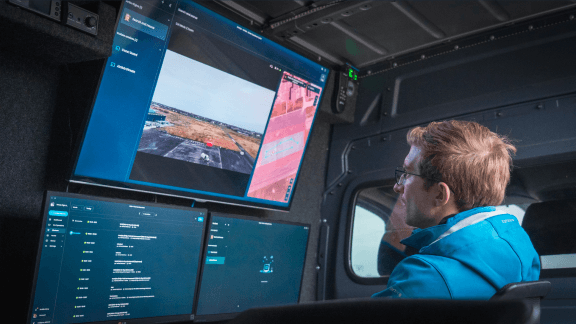
Live video from a drone used to be treated as a bonus. Useful when it worked, but rarely central to the workflow. For public safety teams, corporate security operators and critical infrastructure owners, that has changed completely. Live video has shifted from a peripheral capability to the connective tissue between sensors, dispatchers and decision-makers.
Operators are being asked to do more with less, across more sites, with stricter accountability. A control room cannot wait for a written situation report when the camera is already airborne. What it needs is the camera feed, the map, the dispatch ticket and the response unit in one place. Increasingly, on one screen.
This is the problem AirHub is built to solve.
Why live video streaming sits at the centre of operations
Three forces are pulling live video to the heart of drone operations.
Time compression. In Drone-as-First-Responder programmes such as the one running with Dubai Police, response targets are measured in tens of seconds. A live feed is the decision surface the dispatcher uses to triage, the ground unit uses to approach safely, and the supervisor uses to commit resources.
Multi-sensor verification. A single alarm is noise. An alarm paired with a confirmed visual is an incident. The faster a control room can corroborate sensor data with imagery, from a drone, fixed camera, bodycam or ground robot, the more credible the response becomes.
Accountability and institutional learning. Every feed that is streamed can be archived for after-action review, evidence chains and training. Live video is operational in the moment and becomes institutional knowledge afterwards.
Controlling DJI Dock operations from the drone operations centre
AirHub operates as a Drone Operations Centre (DOC). Within the DOC, an operator can plan a mission, dispatch a DJI Dock, watch the take-off and stream the live feed back to the same screen, all without anyone travelling to the site.
For critical infrastructure owners, this changes the cost equation of inspection and surveillance. A perimeter that used to require a physical patrol can be checked from the dock on a schedule, on a sensor trigger, or on demand from the control room. The video sits next to the mission plan, the airspace map, the geofence and the compliance log.
The same architecture serves public safety. A dock placed on a precinct roof becomes a permanent eye in the sky. When the call comes in, the operator launches autonomously, the feed appears in the DOC, and ground units see the same picture from their mobile devices on the way to the scene.
From the field to the control room: RC to operations centre
The reverse direction matters just as much. When a pilot is on scene with a remote controller, the control room needs that live feed too, without forcing the pilot to manage a second device.
AirHub solves this in two ways.
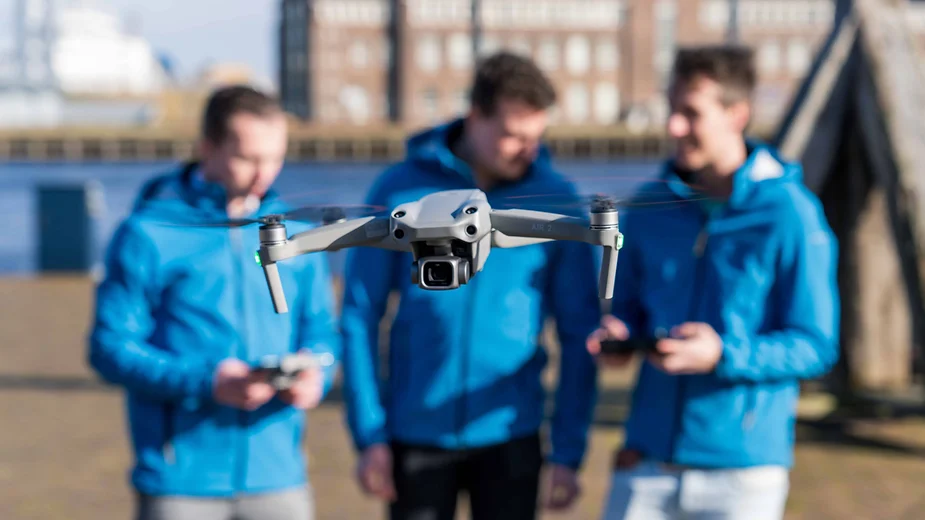
The first is the DJI RC Application for Android, which runs natively on supported DJI controllers and pushes the live video stream from the aircraft into the AirHub platform in one step. The pilot stays focused on flying. The DOC sees what the pilot sees.
The second is open protocol support: RTMP and RTSP. Both are industry-standard streaming protocols and both are fully supported inside AirHub. Any drone, camera or device capable of producing an RTMP or RTSP stream can be ingested into the same operational view. No proprietary plug-in. No vendor lock-in.
The practical result is that an incident stays in one place. The pilot, the operator and the commander are looking at the same frame at the same time.
VMS integrations
For most security and critical infrastructure clients, the control room already runs on a Video Management System. Genetec Security Center and Milestone XProtect dominate that landscape. Asking a security operator to leave their VMS to look at a drone feed is the wrong approach entirely.
AirHub is built to make drones behave like any other camera inside the VMS. Because AirHub streams over open protocols, drone feeds, whether from a DJI Dock under autonomous control or from a pilot in the field, can be exposed into a VMS System. The operator works in the VMS they already know, sees the drone alongside the CCTV, and triggers actions in the workflow they already trust.
This is also where SecHub, AirHub's hardware-agnostic counter-UAS and sensor-fusion layer, plays a role. SecHub brings detection, assessment and response together and feeds the same VMS, so a control room watching a perimeter receives both the drone view and the intruder view in one operational picture.
Beyond drones: bodycams, CCTV and ground robotics
The deeper point is that RTMP and RTSP are video protocols, not drone protocols. Any device that speaks them can be brought into the same workflow.
That opens three immediate possibilities.
Bodycams. Officer-worn cameras streaming over RTMP from the field give the control room the human perspective alongside the aerial one. When the drone shows the wider scene and the bodycam shows the approach, the supervisor has the complete picture.
Fixed CCTV. Cameras at infrastructure sites already produce RTSP. Bringing them into AirHub or into a SecHub-connected VMS removes the artificial wall between drone video and site video.
Ground robotics. Quadrupeds, UGVs and tethered sensors increasingly carry their own cameras. Treating those streams the same way as a drone stream means operators are not learning a new tool every time a new platform arrives on site.
This is what a single operational picture looks like in practice: orchestrating every relevant feed into the workflow the operator already trusts.
What this means for your operations
For a public safety chief, this translates to faster response times and stronger evidence chains. For a critical infrastructure owner, fewer truck rolls and quicker anomaly resolution. For a head of corporate security, one VMS rather than a stack of separate viewers.
The underlying shift is the same across all three: live video is the layer through which every other decision flows. AirHub, SecHub and our VMS partners exist to make that layer reliable, sovereign and operator-friendly, from the dock on the roof to the controller in the hand, and into the screens the control room is already watching.
Want to see how AirHub connects live video across your entire operation? Book a demo and we will walk you through it.