•

Nerissa Goedhart
What Drone as a First Responder means for European public safety

A call comes in. Before a vehicle has left the station, a drone lifts from a dock on a rooftop a few streets away, flies to the address on its own, and starts sending video to the control room. By the time the first unit is on the road, a dispatcher can see how many people are involved, whether anyone is hurt, and which way to send the officers who are coming.
That is Drone as a First Responder, usually shortened to DFR. It has moved from demonstrations to daily use in several parts of the world, and European public safety organisations are now working out what it takes to run one here. This post sets out what a DFR programme actually involves, what the European regulatory path looks like, and which parts decide whether the thing holds up once it is live.
What DFR is, and what it is not
A DFR programme sends a drone to an incident automatically, as part of the standard response, without anyone driving to the location first. The aircraft usually lives in a dock, launches on a trigger from the control room, flies a route it calculates itself, and streams what it sees to the people who need it.
Plenty of public safety organisations already fly drones without any of that. A team gets called out, drives to the scene, unpacks, briefs, and flies. That model is valuable and it is a different thing. The distinction is who moves first. In a drone team model, the drone arrives after people do. In a DFR model, it arrives instead of waiting for them.
The second distinction is who is in the loop. Automated launch does not mean an unattended aircraft. A remote pilot stays in command of every flight, and being able to take manual control at any moment is part of the design rather than an add-on.
Why European organisations are arriving at this now
The regulatory picture has settled enough to plan against. DFR flights go beyond the pilot's visual line of sight, which puts them in the specific category, and that means an operational authorisation from your national aviation authority based on a risk assessment. Since September 2025 that assessment runs on SORA 2.5, which we covered in our piece on SORA 2.5 in the June 2026 Easy Access Rules.
Three things about the European route are worth knowing early, because they differ from how DFR is discussed in other markets.
There is no European certification for a control room. In the United States a proposed rule would put beyond visual line of sight operations under the oversight of a certified operations centre, and that has become a standard reference point in the American conversation. No equivalent exists under EASA rules. The responsible party in Europe remains the drone operator and the remote pilot-in-command, whatever room they happen to be sitting in.
Authorisation is national, and the detail varies. The framework is European, and the interpretation, the processing time and the evidence expectations sit with each national authority. An organisation operating across borders will find the same operation assessed differently in two member states.
Data residency arrives early in the conversation. Where the video and mission data lives, and who can reach it, tends to be part of the authorisation discussion and almost always part of procurement. For a police force this is rarely a technical footnote.
The part that decides whether it works
Here is what the organisations furthest along with DFR tend to say once the novelty wears off. The aircraft is the easy part. What separates a programme that scales from one that stalls is the operation around it.
Three things carry most of that weight.
Coverage and the launch decision. A dock covers a radius, and the radius is set by flight time, airspace and the rules under which you are authorised. So the first design question is not which drone to buy. It is which parts of your area you can reach inside a useful number of minutes, and which calls justify a launch. Programmes that start by mapping coverage against call types tend to make better hardware decisions later.
Keeping a person in command. Automation earns trust by being interruptible. A remote pilot needs live telemetry, a clear picture of where the aircraft is and what it sees, and the ability to take over immediately. That requirement is regulatory and it is also operational: the moment a dispatcher stops believing they can intervene, the drone stops getting launched.
The record. Every automated flight produces an obligation. Who authorised it, who was in command, over which area, at what height, with what result, and can you produce that when an authority, a court or a journalist asks. At one flight a week a spreadsheet copes. At forty flights a day across several docks it does not.
What it looks like when it runs
Dubai Police operates one of the largest DFR networks in service, using AirHub across a city-wide set of docks, with dock-to-scene response inside 90 seconds. The interesting part is that the number holds across a network rather than at a single site, which is a coordination result more than an aviation one. There is more in the Dubai Police case study.
Closer to home, Belgian Police zones use drones for real-time situational awareness during live incidents, including running two aircraft at once so one can hold a wide view of the scene while the other zooms in and relays coordinates to the teams on the ground. Their case study is a good picture of what shared awareness changes about a response, which is the same benefit DFR delivers earlier in the timeline.
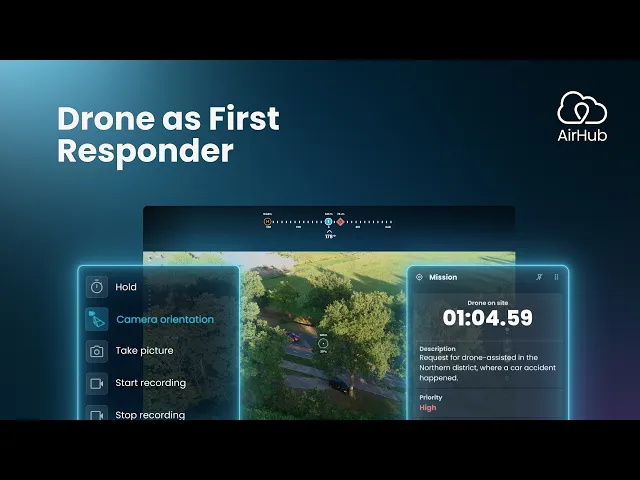
Curious to learn more about our DFR capabilities? Watch the video below:
Where AirHub fits
From 1 September, AirHub's upgraded DFR capabilities go live. They sit on the parts described above rather than alongside them: automated dispatch with a remote pilot in command, automated route calculation, live telemetry with takeover, and a Drone Operations Centre built for a control room running several aircraft and several pilots at once. Live operations and the shared operational picture underneath it are the same tooling that public safety teams already use for incident response, which is the point: DFR is a way of starting the response earlier rather than a separate system to run in parallel.
The platform is hardware agnostic and European hosting and deployment options are part of the architecture, which matters for the data residency question above.
Where to start
If your organisation is considering DFR, the useful first steps are unglamorous. Map which parts of your area a dock could reach inside a target response time. Decide which call types would justify an automatic launch, and which would not. Talk to your national authority early about the authorisation route, because that conversation sets your timeline more than procurement does. Work out who sits in the control room, what they see, and how they take over. And decide where your data will live before anyone asks you.
Our public safety page sets out how the platform supports each of those, and we are happy to walk through what a programme in your area would involve.