•

Stephan van Vuren
Why indoor drones are becoming essential for public safety, security, and critical infrastructure
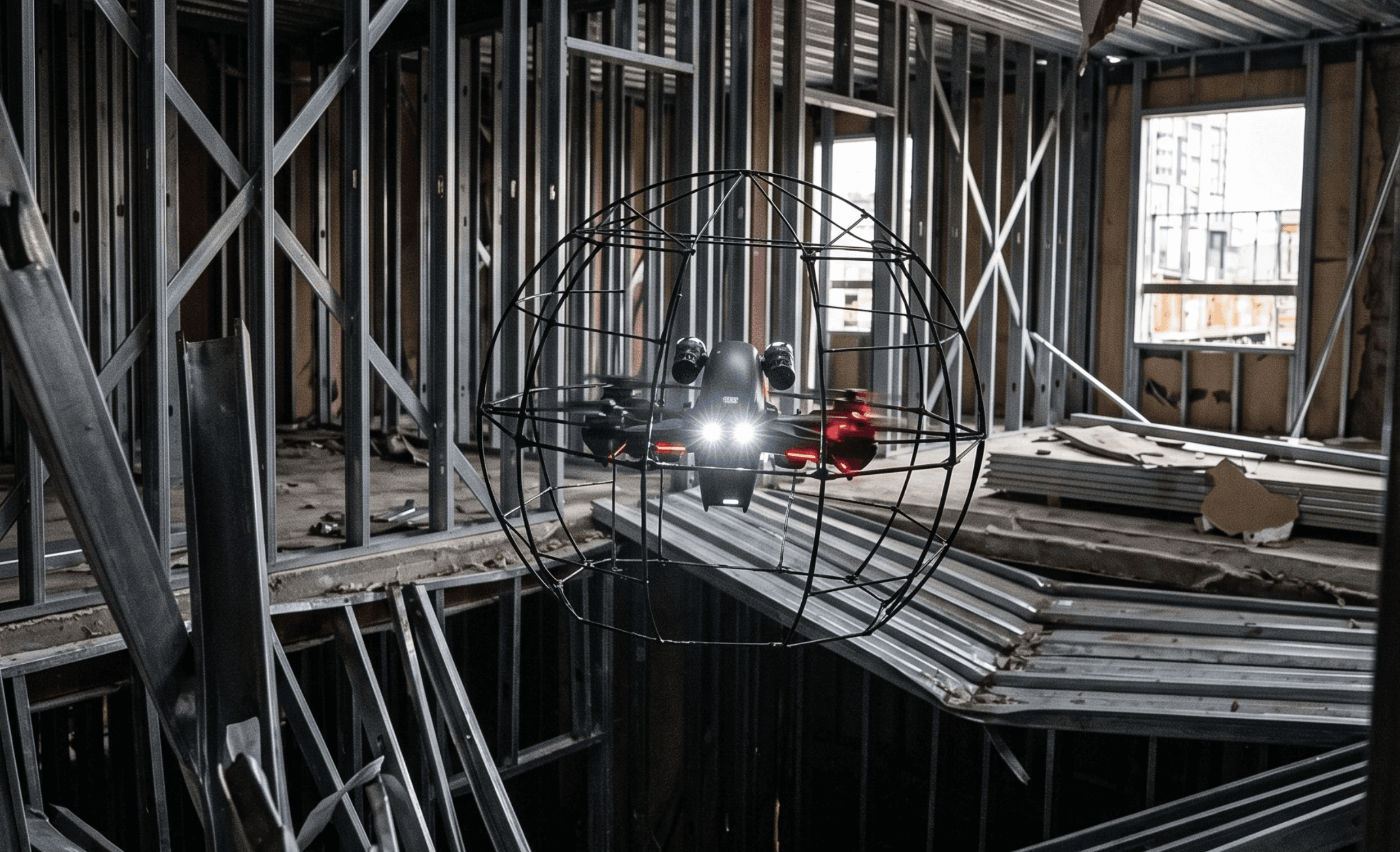
For years, drones have primarily been associated with outdoor operations. But one of the fastest-growing developments in the drone industry is happening indoors, and it is changing how organisations operate in environments where GPS is unavailable, human access is dangerous, or situational awareness is limited.
Border surveillance, infrastructure inspections, search and rescue missions, and Drone as First Responder (DFR) programmes have long focused on open-air environments. That is starting to change.
From compact platforms such as the DJI Neo 2 to autonomous tactical systems like the Skydio R10, and specialised confined-space inspection drones such as the Flyability Elios series, indoor drone technology is rapidly becoming a serious operational capability for public safety agencies, security organisations, and operators of critical infrastructure.
Why indoor drone operations matter
Indoor environments create some of the most challenging operational conditions imaginable:
No GPS availability
Limited visibility
Tight spaces and obstacles
Dangerous or contaminated environments
Poor communication coverage
Confined spaces
Complex industrial layouts
Traditionally, inspections or interventions in these environments required workers to enter hazardous confined spaces, operations to be shut down, scaffolding or rope-access teams to be deployed, or first responders to be exposed to unnecessary risk.
Indoor drones fundamentally change this equation. Modern systems use combinations of LiDAR, computer vision, Simultaneous Localisation and Mapping (SLAM), AI-based obstacle avoidance, thermal imaging, and autonomous navigation to safely operate in environments where conventional drones would struggle or fail entirely.
Indoor drones in Public Safety
For public safety organisations, indoor drones provide a completely new layer of situational awareness inside structures that previously required sending personnel in blind.
Building clearing and tactical awareness
Police and special intervention teams increasingly face situations where entering a building is extremely dangerous. Examples include active threat incidents, hostage situations, industrial accidents, collapsed structures, underground facilities, tunnels, or smoke-filled environments.
Indoor drones can enter first, providing live video feeds, thermal imagery, real-time mapping, and threat assessment capabilities before a single officer steps through the door. Compact drones with protective designs and advanced stabilisation can navigate hallways, staircases, warehouses, and confined indoor areas while significantly reducing risk to officers and first responders.
Systems such as the Skydio R10 add another layer by combining autonomous navigation, AI-driven obstacle avoidance, and reliable operation in GPS-denied environments. This makes them particularly relevant for tactical public safety missions where maintaining operational awareness inside complex structures is critical.
Search and Rescue
Indoor drones are also becoming highly valuable during:
earthquake response,
industrial disasters,
tunnel incidents,
and collapsed-building searches.
Rather than sending responders blindly into unstable structures, drones can first assess structural damage, search for victims, identify hazards, and create real-time maps of the environment. This improves responder safety while accelerating decision-making during time-critical operations.
Live situational awareness shared directly to a command centre means decision-makers have eyes on the scene instantly, regardless of where they are located.
Underground and tunnel operations
Underground infrastructure is another major use case.
Metro systems, rail tunnels, underground utility corridors, and industrial tunnels are often difficult and dangerous to inspect manually. Indoor drones enable operators to remotely inspect these environments while maintaining live situational awareness.
As autonomous navigation technology continues to improve, drones are increasingly capable of operating in environments with limited lighting, narrow passageways, dust, smoke, or degraded communications.
Indoor drones for security operations
Security organisations are also beginning to adopt indoor drones as part of integrated situational awareness and security systems. This is a natural extension of the shift towards autonomous drone operations that is already well underway in the outdoor security sector.
Warehouse and facility patrols
Large warehouses, logistics centers, and industrial sites are difficult to monitor continuously using only fixed cameras.
Indoor drones can provide dynamic patrol capabilities, rapid alarm verification, autonomous inspections, and access to areas that static CCTV systems cannot effectively cover. This is particularly valuable during night operations, power outages, restricted-access situations, or incidents involving hazardous materials.
Rapid incident response
In high-security environments such as:
ports,
energy facilities,
data centers,
airports,
and industrial plants,
indoor drones can be deployed immediately after alarms or incidents to assess situations before personnel enter.
This allows security teams to verify threats, monitor unauthorised access, inspect suspicious objects, or assess damage following an incident.
Over time, indoor drones will increasingly become part of broader security ecosystems sitting alongside CCTV, access control systems, intrusion detection, counter-UAS (C-UAS) systems, and centralised operational command platforms.
Critical infrastructure: one of the largest growth areas
Perhaps the biggest long-term market for indoor drone operations is critical infrastructure inspection. Industrial operators routinely need to inspect storage tanks, silos, boilers, chimneys, pipelines, ballast tanks, tunnels, and processing facilities. These inspections are traditionally expensive, slow, dangerous, and operationally disruptive.
Confined space inspections
This is where specialised platforms such as the Flyability Elios series have created enormous operational value. These systems are specifically designed for confined-space inspections using collision-tolerant cages, LiDAR mapping, SLAM-based navigation, and high-resolution imaging. Rather than shutting down operations for extended periods or sending workers into hazardous environments, operators can perform inspections remotely while reducing downtime and safety risks significantly.
The cost savings are equally compelling. According to a 2019 survey by the American Association of State Highway and Transportation Officials (AASHTO), drone inspections can reduce inspection costs by up to 74% and cut inspection time by up to 88% compared to traditional manned methods, while keeping personnel safely on the ground throughout.
Digital twins and asset management
Indoor drones are also becoming important tools for digital twin generation, 3D mapping, predictive maintenance, and asset lifecycle management. By autonomously scanning facilities and infrastructure assets, drones help operators monitor degradation over time, compare inspection datasets, identify defects early, and reduce manual inspection frequency. For operators managing refineries, energy infrastructure, water facilities, transportation networks, manufacturing plants, and ports, this creates significant efficiency, safety, and maintenance advantages.
The technology behind indoor Drones
Indoor drone operations are fundamentally different from traditional outdoor flights. Because GPS is unavailable indoors, these systems rely heavily on onboard autonomy, computer vision, LiDAR, AI-based navigation, and advanced obstacle avoidance.
The Skydio R10, for example, is designed to operate reliably in GPS-denied environments while maintaining advanced situational awareness and autonomous flight capabilities.
The Flyability Elios platforms combine LiDAR mapping and SLAM technology to generate real-time 3D awareness during confined-space inspections.
Even smaller systems such as the DJI Neo 2 are making indoor operations more accessible through compact form factors, stabilized flight, and improved obstacle sensing capabilities.
Indoor drones and the future of autonomous operations
Indoor drones are becoming part of a much larger shift toward autonomous robotics and integrated situational awareness.
In the coming years, we are likely to see autonomous indoor patrol routes, indoor Drone-in-a-Box (DiaB) systems, robotic collaboration between aerial and ground systems, automated emergency response workflows, and AI-assisted inspection analysis.
For organizations operating critical infrastructure or security-sensitive facilities, indoor drones are no longer simply “flying cameras.” They are evolving into intelligent robotic systems that extend human capabilities while reducing operational risk.
Conclusion
Indoor drone technology is still at a relatively early stage compared to outdoor drone operations, but its operational value is already becoming clear.
For public safety organizations, indoor drones improve situational awareness while reducing risk to first responders.
For security teams, they enable faster and more dynamic incident response capabilities.
For critical infrastructure operators, they significantly improve inspection efficiency, safety, and asset visibility.
As autonomy, AI, indoor positioning, and sensor fusion continue to mature, indoor drones will likely become a standard operational tool across a wide range of industries.
And while the platforms may differ, from lightweight systems like the DJI Neo 2 to autonomous tactical platforms like the Skydio R10 and specialised confined-space inspection systems from Flyability, the direction of travel is clear: the future of drone operations is not only outside in the open air, but increasingly inside the world’s most complex and critical environments.
Interesting in what AirHub can do for your business? Book a demo and find out more.