•
Stephan van Vuren
One continuous workflow: how modern public safety drone operations run from CAD to dock fleet

A modern police force is buying a workflow. The drone is one part of it.
That distinction matters more than it sounds. A drone on its own is a sensor on a stick. A drone programme is a set of decisions stitched together. A call comes in, an aircraft launches, a feed reaches the operator, a unit on the ground acts on it, the airspace stays safe, the evidence is preserved, the fleet stays ready. The drone is one component of that chain. The platform that holds the chain together is the system the chief is actually procuring.
What follows is how public safety drone operations should run, end to end, in 2026. It is the model AirHub is built around. Dubai Police already runs it as a live, city-wide Drone as First Responder network, and it is the direction public safety teams across Europe and the Middle East are moving towards.
The scenario, in one paragraph
An emergency call reports an armed individual at a transit station. Computer-Aided Dispatch (CAD) creates the incident. AirHub receives the ticket, identifies the nearest rooftop dock, launches a docked aircraft autonomously, and streams the feed back to the duty operator within seconds. The AI layer flags a person matching the description. The counter-UAS layer confirms no hostile drones in the area. The feed appears in the control room alongside the station's CCTV, and is pushed to the responding units on their mobile devices. Every action, every frame, every command is logged. The aircraft returns to dock, recharges, and is ready before the next incident. A pilot supervises throughout, without driving to the scene.
That is the loop. Here is what happens underneath.
Stage 1: CAD brings the incident into the workflow
The trigger is always a dispatch system. Computer-Aided Dispatch, whether Hexagon, Frequentis or a regional platform, is where a 112 or 911 call becomes a structured incident: location, type, priority, units assigned.
For a drone programme to be operationally relevant, the dispatch system has to reach the drone platform automatically. A manual workflow, where a dispatcher sees a call, picks up a phone and asks for a drone, adds minutes the operation does not have. In Drone-as-First-Responder deployments, the target response time is measured in tens of seconds. Dubai Police operates against a sub-ninety-second target across the city, and that target collapses without CAD integration.
AirHub connects to dispatch systems through its open API, so an incident created in a CAD platform can task a drone automatically. The incident type and location determine which dock is nearest, what altitude profile to fly, what camera angle to default to, and which sensors to enable on the way.
The principle here is straightforward. The dispatcher keeps working as a dispatcher. The drone becomes another unit they can task.
Stage 2: the dock takes the call
The next stage is the launch. In a serious programme, this happens without anyone going to the rooftop.
A dock, whether a DJI Dock, a Skydio Dock or another drone-in-a-box system AirHub orchestrates, sits on a precinct roof, a tower or a perimeter mast. When the CAD-triggered tasking arrives, the dock opens, the aircraft takes off, climbs to the configured altitude and proceeds to the incident. The duty operator sees the launch confirmation, the live feed and the telemetry within seconds of the call being created.
The aircraft is not flying blind. AirHub has already checked the airspace, validated the geofence, applied the relevant operational area and contingency volume, and selected a flight path that respects the ground risk buffer. The pilot, formally the remote pilot in command, supervises the flight. That is what the regulatory framework intends, and it is what lets a programme scale beyond the limits of manual piloting.
For programmes that mix docked and field-deployed assets, the same workflow runs in parallel. A patrol unit with a controller in the car can be tasked through AirHub the same way a dock is. The dispatcher does not need to know which one is closer. The platform does.
Stage 3: AI image recognition makes the feed actionable
A live video feed is useful. A live feed that flags relevant objects automatically is decisive.
AI at the aircraft and platform layer can detect and classify objects such as people, vehicles and anomalies, with further mission-specific modules. The aircraft picks up the visual scene and the AI layer turns it into structured events. A person matching a description becomes an alert with a timestamp, a location and a frame, instead of staying buried in twenty minutes of orbiting footage.
For the operator, this turns passive watching into active searching. A duty officer can supervise several live feeds at once when the AI is doing the looking.
For investigators afterwards, the AI layer makes the footage searchable. A query like "show me every vehicle that passed the south entrance between 22:00 and 23:00" becomes a short task rather than a long manual review.
The important point is that AI is a support layer. The platform surfaces information and the human makes the decision. AirHub is designed around that boundary deliberately, and it is part of how we build programmes that hold up to scrutiny from prosecutors, ombudsmen and procurement auditors.
Stage 4: counter-UAS detect and avoid keeps the airspace safe
Once a public safety drone is airborne, a second question matters just as much. What else is in the airspace around it?
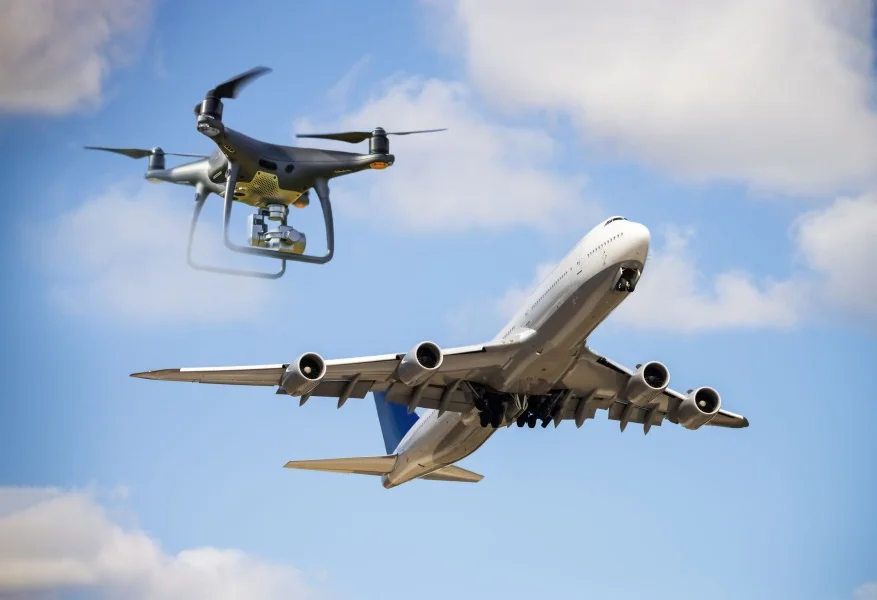
This is where the counter-UAS layer enters the workflow. Detection sensors, including radar, RF, acoustic, Remote ID receivers and visual systems, feed the same operational map the drone is flying on. Cooperative manned traffic appears via ADS-B, gliders and light aviation via FLARM, and non-cooperative drones via the counter-UAS sensors.
For the operator running the mission, this gives two things. The first is deconfliction. If a police helicopter is inbound, the drone descends or repositions before either pilot has to make a radio call. The second is threat awareness. An unidentified drone approaching the same incident becomes a track on the map, with a classification, a heading and a confidence score.
In the AirHub ecosystem this is the SecHub layer, a hardware-agnostic sensor-fusion and counter-UAS engine that brings detection, assessment and response into the same operational picture as the friendly drone. For public safety, that combination is increasingly essential. A programme that ignores the counter-UAS dimension will eventually fly into a problem it could not see coming.
Stage 5: VMS integration gets the feed to the people who need it
The control room running the incident is rarely a drone control room. It is a security or command-and-control room running on a Video Management System (VMS) such as Genetec Security Center, Milestone XProtect or Hexagon HxGN OnCall. The operator there has spent years learning that VMS, so asking them to leave it for a separate drone view is the wrong design.
The right architecture puts the drone feed inside the VMS as a native video source, alongside the fixed CCTV, the bodycams, the ANPR cameras and any other tile the operator already works with. AirHub streams over open protocols such as RTSP and RTMP, so a VMS can take the feed as a standard video source without a bespoke build for every site.
The effect on the operator is significant. The drone feed sits next to the perimeter CCTV. The counter-UAS detection sits as an alert layer. The bodycam from the responding officer sits in the next tile. One operator, one toolset, one operational picture.
This is also where SecHub closes the loop. The same VMS that shows the drone feed shows the counter-UAS detections, so the operator who sees the threat is the operator who can act on it.
Stage 6: video sharing makes the field part of the operation
Not everyone who needs the feed is in the control room. The patrol unit en route, the supervisor in the command vehicle, the tactical team on the perimeter, the prosecutor on call, the partner agency on a joint operation. All of them may need access, with different permission levels, for different durations.
A modern drone platform treats video sharing as a first-class function. A live link, a time-limited token, a permission set that determines who can see what, and a mobile-friendly interface that works on the device the field user already carries. AirHub lets the operator in the control room push the feed to the right people in seconds, without copying files, without sending screen recordings, and without losing track of who saw what.
The principle is the same as elsewhere in the workflow. The feed follows the operation, to the people who need it, for as long as they need it.
Stage 7: logging the evidence chain and audit trail
Everything that happens in the workflow is logged. It is captured as a structural property of the platform, built in from the start.
Flight logs, pilot identification, airspace clearances, geofence applications, contingency volume definitions, ground risk buffer parameters, AI events, counter-UAS detections, video segments, who watched which feed at what time, and which patrol unit had access for how long. All of it is captured, timestamped and retrievable.
This matters for three audiences. The first is the prosecutor, because footage from a drone is only as useful as the chain of custody around it. The second is the regulator, because every BVLOS approval, population overflight and special authorisation comes with the obligation to demonstrate that the operation ran as approved. The third is the chief, because an annual review of the programme should take a query rather than six people and a month of forensic effort.
AirHub treats logs as the institutional memory of the programme. They let an operation stand up to scrutiny.
Stage 8: fleet management keeps the docks ready for the next call
The last stage determines whether there is a next workflow.
A docked drone is only useful if it is ready when the next call comes in. That means batteries charged and within cycle limits, propellers within service life, sensors calibrated, firmware current, geofences valid, weather within the operating envelope, connectivity verified, pilots in the supervision roster and current on their requirements, and maintenance scheduled before it falls overdue.
Across a fleet of ten docks, this is manageable by hand. Across a fleet of a hundred, it decides whether the programme can scale.
AirHub treats fleet management as a first-class function. Every dock, aircraft, battery, controller and pilot has a state, visible to the programme manager in one place, with proactive flags before something becomes a problem. Maintenance windows are scheduled around expected demand. Pilot rosters are aligned with dock readiness. Battery cycles are tracked against manufacturer envelopes.
The workflow is the product
When people discuss public safety drone programmes, it is tempting to focus on the aircraft. The aircraft is the visible part. It is also the smallest part of the system the operator is actually buying.
What a serious public safety force is procuring is a platform that holds the whole chain together, from a citizen's call to a closed case file. CAD integration at the front. Autonomous launch in the middle. AI, counter-UAS, VMS integration, sharing, logging and fleet management woven through. That platform stays sovereign and on-premise where the operator requires it, and hardware-agnostic across DJI, Skydio, Parrot and the open protocol world.
That is what AirHub, SecHub and our partner ecosystem are built to deliver. The drone is part of the picture. The picture is the product.
Curious how AirHub runs this workflow end to end for public safety teams? Book a demo with one of our experts.